The Redress Movement
In the late 1970s, the redress movement, critically involving the San Francisco Bay Area, was led by JACL (Japanese American Citizens League) and NCRR (National Coalition for Redress/Reparations), calling for the government to take responsibility for the wrongful internment of Japanese Americans.
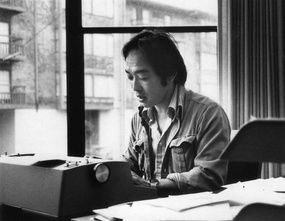
Tateishi. Image courtesy of Discover Nikkei.
From San Francisco, John Tateishi, the leader of the JACL, states in an interview:
"This is an issue that is about the Constitution and the future [of this country]. We were determined to pass [the Civil Liberties Act] as a way of having Americans recognize the injustice of what happened to us—not for our sake, but in order to make sure this never happened again."
- John Tateishi, Densho Interview
Alan Nishio also speaks about being a leader in NCRR:
"We created NCRR ... it just took on a much larger scope than I had ever imagined. And at a certain point, it was just not a political -- for me it was a political issue, to continue organizing, etcetera, but then it became, quote, "personal," but also a commitment to community that we had to see this thing through."
- Alan Nishio, Densho Interview
CWRIC Bill
In 1980, two years after starting the redress campaign, the Commission on Wartime Relocation and Internment of Civilians (CWRIC) bill was passed, creating a nine-member panel that conducted commission hearings examining the government's actions.
Commission Hearings
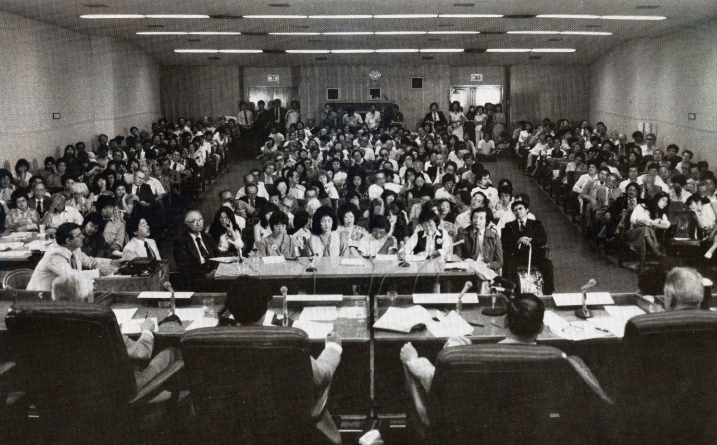
Hearing in Los Angeles. Image courtesy of Densho.
"We had reached a certain point, we had the commission hearings, the response on that was just incredible. It was overwhelming. That was the single most important part of the redress campaign, it changed the way Americans viewed Japanese Americans."
- John Tateishi
The hearings conducted by the panel allowed voices not only to fight for change, but to start the healing of a community that had been forced to remain silent.
“It’s really quite an emotional process when I reopen and read some testimonies here and there. I can actually remember the people. Their voices come back into my thinking. There’s a healing thing about being heard, being listened to finally. It wasn’t just for the commissioners.”
- Naomi Kubota Lee
Stories about internment began circulating nationally, and the commission determined that Japanese Americans were unjustly incarcerated due to "racial prejudice, wartime hysteria, and a failure of political leadership", with it recommending Congress and the president to apologize and compensate $20,000 to each surviving victim.
Civil Liberties Act of 1988
Almost ten years after the start of the redress movement, President Ronald Reagan signed the Civil Liberties Act of 1988, authorizing redress payments for Japanese Americans and taking responsibility for the "grave injustice done to citizens and permanent resident aliens of Japanese ancestry by the evacuation, relocation, and internment of civilians during World War II."
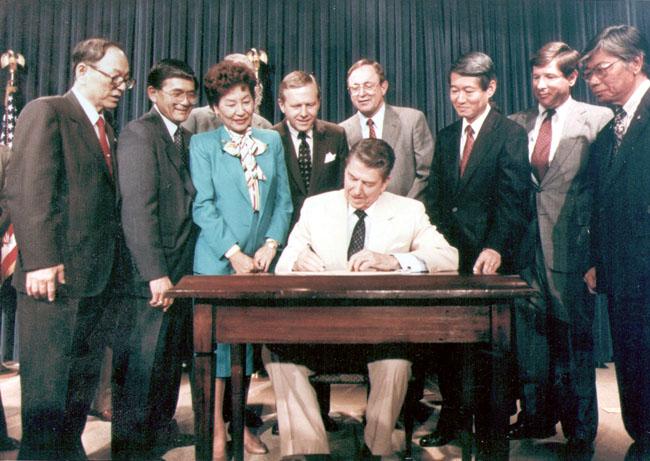
Reagan signing the Civil Liberties Act of 1988. Image courtesy of Nichi Bei News.